

Data Science in Utah
In spring 2022, Lindsey Henderson, the secondary math specialist for the Utah State Board of Education, decided to bring data science to Utah high schools and forged a path with surprising supports and expected challenges. Four months later, in October of 2022, Ms. Henderson started convening a group of teachers and administrators who were interested in learning more about data science. The following year, at the start of the 2023-2024 school year, the first cohort of Utah high school Data Science Pilot math teachers taught a high school data science course for the first time.
“My personal belief after 18 years in education before I took this job, was that math has a PR problem. I kept hearing the noise and the rumblings in Utah about this data science and what potential data science held…[as a] modernized version of statistics with technology tools. To me, that sounded really interesting. So when I took my position at the State Board of Education…I was like..‘what would it take to start a pilot like this, to start getting this into classrooms and getting students involved in it?’”
“What would it take to start a pilot like this, to start getting this into classrooms and getting students involved in it?”
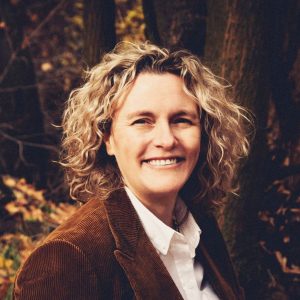 At the outset, Ms. Henderson quickly gained support from local tech leaders in “Silicon Slopes,” who explained that professionals trained in data science were in high demand, and most importantly, from teachers who wanted to teach applicable real-world math. She then worked to get data science approved as an “opt-out course” to traditional Secondary Math III, which enabled students to receive credit towards graduation requirements. She also eventually worked with Utah higher education math administrators to get a temporary agreement in place that would allow introductory data science to serve as a prerequisite course for a college-level dual-enrollment statistics class.
After identifying four seemingly-appropriate data science math curricula, Lindsey Henderson put in a request for funding to begin teacher training. “I asked for like $200,000…I got $20,000. I usually tell people it’s $5…It gave me a starting point.”
The next step was to recruit teachers to actually teach the course. Ms. Henderson used every opportunity she had to spread the word about the pilot. “At every presentation that I gave or every keynote that I gave or every newsletter that I sent out, I would have something that was data science related and I’d share, remember we have this opportunity. It’s a two-year program. You can come learn get trained and then you implement this alternative to secondary math 3 in your classroom or an elective fourth-year math course for your for your school.’”
The interest level was high. At one point, there were as many as sixty teachers and administrators expressing a desire to bring data science to their school or district. For a range of reasons such as other commitments or lack of community support, as the school year approached, the numbers decreased, and ultimately 15 teachers from seven school districts enrolled students in data science courses. The smaller number made it possible to fund every teacher’s curriculum-provided professional development training with the $20,000 allotted.
“[From] just me at the State Board of Education saying ‘this is a priority,’ I was surprised at how many people came out to support it…”
The participating teachers were not the only people showing interest and support for high school data science education. “[From] just me at the State Board of Education saying ‘this is a priority,’ I was surprised at how many people came out to support it. I really was, and some of the interviews I’ve done with the press, I have never had any public pushback other than, yes, math needs a change. This is a great thing for our students. Nobody in any part of the process came out publicly against it, and that was really actually surprising to me. Everybody seemed really on board.”
“Everybody was really excited. Like teachers were excited to teach something where kids weren’t rolling their eyes and not coming to class anymore. Administrators were excited to have a rigorous 3rd or 4th year mathematics option for students because they want kids to get their diplomas, they don’t want kids to be held back by not earning their diploma–same with counselors…parents were like data science, YES, that’s a great course. There are still some parents that want their students to take calculus–and we have that path, we’re really proud of that. It turns out to only reach about 8% of kids in the state of Utah. So, the other 92% of kids also need a rigorous opportunity for mathematics that isn’t calculus.”
“It turns out [calculus] only reach[es] about 8% of kids in the state of Utah. So, the other 92% of kids also need a rigorous opportunity for mathematics…”
Simultaneously, other initiatives were taking place in Utah that would help grow data science education. In September 2023, educators, tech leaders, and organizations hosted a summit to raise awareness on the importance of k-12 data science education in Utah. The Utah legislature was listening and eventually earmarked several million dollars of funding to go towards computer science education, some of which will ultimately be allocated to data science education. This funding should enable more teachers to be trained to teach data science, and Ms. Henderson believes this can spread beyond math teachers. “I think computer science teachers should be able to teach this data science class with a little bit more math training and then I think the math teachers should be able to teach it with a little bit more computer science training.”
Additionally, Utah’s integrated standards and math pathways are being revisited and revised. “There was a lot of public comment about [how] this [traditional] math isn’t useful in high school. And it was from parents, students, and teachers.” Many were ready to welcome a change in the standards and “felt like data science could help them accomplish that.” Current stakeholders hope to integrate more statistics into the math standards and are discussing offering two third-year high school math course options, one that focuses more on advanced algebra, which will prepare students for calculus, and one that focuses on data science, statistics, and mathematical modeling, and will prepare students for college-level statistics. These potential policy-level changes would likely make data science much more prevalent and universal in Utah high schools.
Lindsey Henderson hopes to see real progress made in math education, but recognizes there are risks and challenges in any change. “This giant system that we have still needs to evolve. And it seems like the pathway to mathematical excellence hasn’t changed since 1896, when the Committee of 10 report came out about taking algebra, geometry, algebra II. Trying to …[do]something innovative … is messy work and it’s hard and it’s scary.”
“The data science pilot teachers are the innovators in the state of Utah and they refill my emotional cup every time I get to work with them.”
Despite all of the challenges and effort that has gone into the Data Science Pilot, it continues to be a highlight of Ms. Henderson’s job. “The data science pilot teachers are the innovators in the state of Utah and they refill my emotional cup every time I get to work with them. Because all I’m doing is empowering them and giving them the safety net of the State Board of Education to do what they are doing in their classrooms which is to bring really important mathematical experiences to kids. And that…that makes me feel amazing.”
The Utah Data Science Pilot will begin its second year at the start of the 2024-2025 school year. Approximately eight new teachers have signed on to teach data science. Additionally, the majority of the first cohort teachers plan to teach data science again, and many anticipate higher student enrollment next year.